

Silicon Steel vs. 80NiFe: A Total Cost Analysis for Magnetic Shielding
Posted by Josh Wickler, Vice President of R&D on Oct 28th, 2026
Key Takeaways
- Cost per dB is the metric that matters, not cost per kilogram. * Silicon steel's low material price is often offset by the need for greater thickness, weight, and volume to achieve the same shielding factor as a high-permeability 80NiFe alloy.
- Permeability at the operating field strength determines performance. * In typical low-field shielding applications, properly annealed MuMETAL® has significantly higher permeability than silicon steel, resulting in a much higher shielding factor from a single layer.
- Fabrication adds hidden costs. * Silicon steel is more difficult to form and weld into sealed enclosures than ductile 80NiFe alloys, leading to higher labor costs and greater rework risk. Both materials require a post-fabrication anneal to restore magnetic properties.
- Silicon steel has a niche role. * It can serve as a high-saturation outer layer in a multi-layer shield designed to attenuate very strong ambient fields, but purpose-designed alloys like NETIC® are often a better fit.
- High-demand applications expose silicon steel's limits. * For quantum computing, cryogenic systems, and sensitive medical instruments requiring nanotesla-level residual fields, silicon steel is not a viable option regardless of price.
The question of whether silicon steel is cost-effective for magnetic shielding often begins with a tempting price comparison. An engineer sees that grain-oriented silicon steel (GOSS) costs roughly one-fifth as much per kilogram as a high-permeability 80NiFe alloy like MuMETAL®. The math seems simple. But this comparison overlooks the physics of magnetic field control.
Consider a team building an enclosure for a SQUID magnetometer. They source silicon steel, fabricate a double-layer box, and measure the internal field. It's still an order of magnitude higher than the specification. The low-cost material choice has led to a high-cost failure. The project now faces scrapping the enclosure and starting over with the correct material, doubling the total project cost.
The true cost of a magnetic shield is not the price of the raw material. It is the total installed cost to achieve a specified residual field. This article provides an engineering analysis comparing silicon steel to 80NiFe alloys, focusing on the factors that determine total cost: material properties, required thickness and weight, fabrication realities, and application-specific performance limits.
Why Material Price Per Kilogram Misleads: Permeability and Saturation Compared
The effectiveness of a closed magnetic shield is driven primarily by the material's relative permeability at the operating flux density, not its price. This is where the comparison between general-purpose electrical steel and purpose-designed shielding alloys begins.
Grain-oriented silicon steel (GOSS), governed by standards like ASTM A876, is optimized for transformer cores. It can achieve a maximum relative permeability of roughly 30,000–50,000, but its initial permeability the permeability at very low field strengths is only around 1,500. In contrast, an 80NiFe alloy like MuMETAL® (conforming to UNS N14080 and ASTM A753 Alloy 4) reaches a maximum permeability well above 100,000 and an initial permeability over 20,000 after a proper final dry hydrogen annealing cycle.
This difference is critical because permeability is not a fixed constant; it changes with the applied magnetic flux density, as shown by a material's B-H curve. Imagine shielding a sensor from a typical ambient DC field of 50 microtesla. At this low flux density, MuMETAL® operates near its region of maximum permeability, providing a very high shielding factor. GOSS, however, operates far below its peak, delivering a much lower effective permeability. Comparing the two materials based on their datasheet maximums is an engineering error. For more detail on how these properties translate to real-world designs, explore our shielding FAQs .
Where silicon steel does have an advantage is in saturation induction (Bs). GOSS saturates near 2.0 Tesla, whereas 80NiFe alloys saturate around 0.8 T. This high saturation point is only an advantage when the shield must attenuate a very strong field typically above several hundred microtesla that would push the 80NiFe alloy toward saturation. In most laboratory, medical, and electronics shielding scenarios, the ambient fields are far too low for saturation to be a concern for either material, making the superior low-field permeability of the 80NiFe alloy the dominant factor.
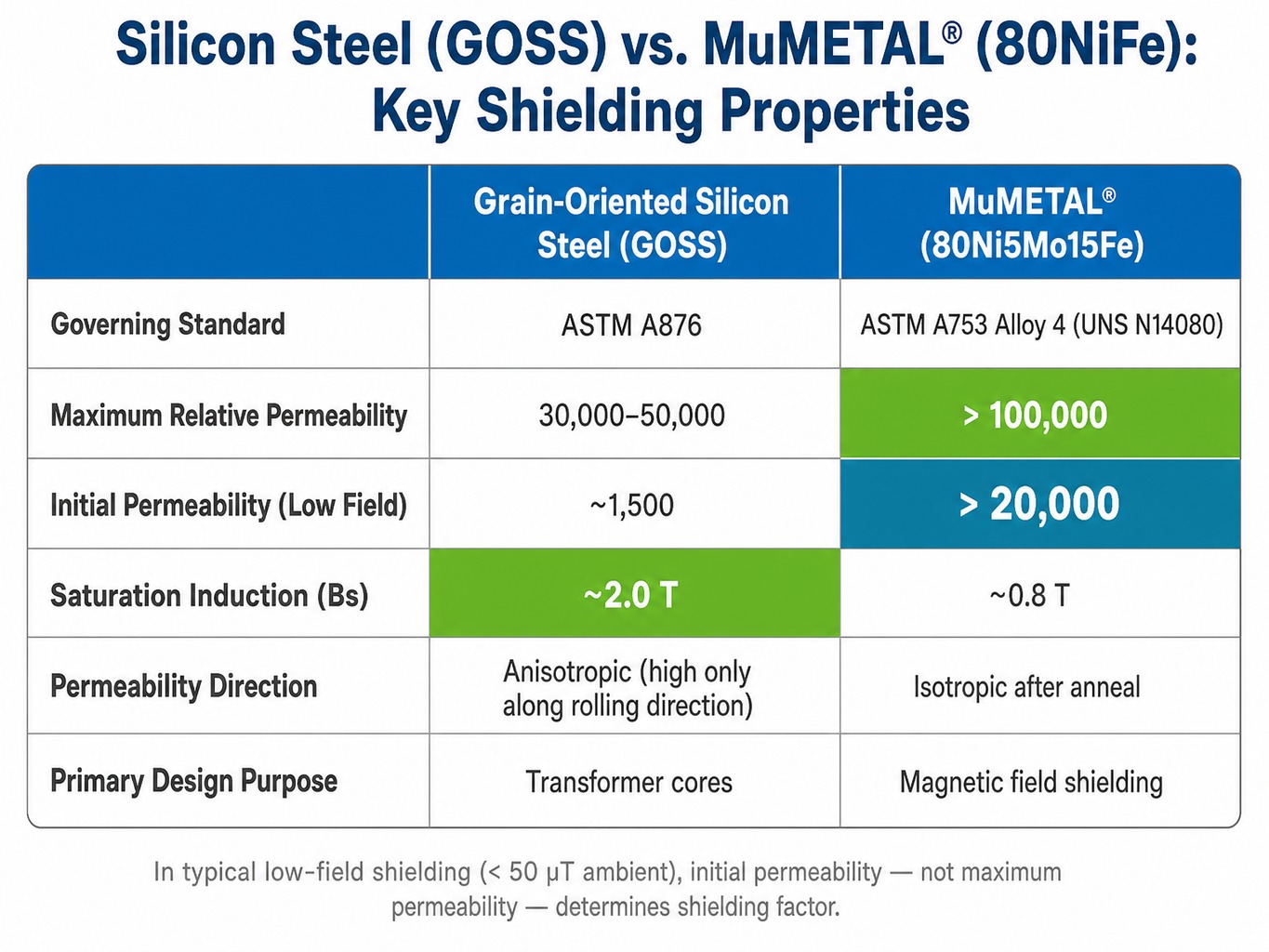
Initial permeability, not price per kilogram, determines steel magnetic shielding performance.
How Many Layers of Silicon Steel Replace One Layer of MuMETAL®?
When faced with the higher per-sheet cost of MuMETAL®, engineers commonly ask whether they can simply use more layers of cheaper silicon steel and come out ahead. The answer lies in the physics of shielding and the practicalities of weight and volume.
For a simple cylindrical shield, the shielding factor scales approximately with the product of permeability and thickness, divided by the diameter. Because the effective permeability of GOSS falls well below that of properly annealed MuMETAL® at typical low ambient field strengths, it must make up the difference in thickness: matching the shielding factor requires at least two to three times the material thickness, and considerably more when the operating point sits close to GOSS's low initial permeability.
Consider a shield requiring a specific DC attenuation. A single layer of 1.58mm (.062") MuMETAL® might provide the target shielding factor. To achieve the same performance with GOSS, you would need approximately 3.18mm (.125") to 4.75mm (.187") of total material thickness, depending on the specific geometry and field conditions. Because GOSS is typically produced as thin sheets or laminations rather than thick plate, achieving that thickness would require stacking multiple sheets or, more effectively, using multiple nested shells separated by air gaps.
This layering penalty immediately erodes the material cost advantage. The silicon steel shield now weighs roughly twice as much and consumes significantly more volume. In space-constrained applications like aerospace avionics bays, medical equipment housings, or rack-mounted electronics, this added weight and volume can rule out the design, introducing integration problems that have their own associated costs. The correct metric for comparison is not cost per kilogram but shielding factor per unit mass, which almost always favors the higher-permeability material.
As a practical threshold, this tradeoff typically tips against silicon steel once the required attenuation at DC or extremely low frequencies (ELF) exceeds 20 dB.
Fabrication, Welding, and Annealing: Where Hidden Costs Accumulate
The majority of a shielding project's budget is spent on fabrication, not raw material, and it is here that silicon steel's apparent cost advantage often disappears. When a shielding project selects material on price alone and then requires a second design-fabrication-test cycle to meet the actual attenuation specification, the rework cost typically exceeds the original budget by 40 to 100 percent.
Formability and Welding Differences
GOSS is designed to be stamped into flat laminations for transformer cores, not formed into three-dimensional enclosures. Its anisotropic properties mean its high permeability exists only along the grain (rolling) direction; permeability in the transverse direction can be an order of magnitude lower. An enclosure built from GOSS panels cut in different orientations will have inconsistent, direction-dependent shielding. Furthermore, the 3-3.5% silicon content makes the material brittle, prone to cracking at tight-radius bends, especially when bent across the grain.
In contrast, high-permeability alloys like MuMETAL® are ductile and designed for forming using standard sheet-metal techniques like brake forming, deep drawing, and hydroforming. As a material, MuMETAL® is also readily weldable via TIG, spot, and laser methods, which allows for the fabrication of complex, fully sealed enclosures. While silicon steel can be welded, the high silicon content makes weld zones brittle and susceptible to cracking. The heat from welding also disrupts the grain structure, creating localized low-permeability zones that act as "holes" for magnetic flux to leak through. Where an enclosure needs an opening for cables or access, a shielding collar welded around the aperture should extend outward by a distance equal to or greater than the hole diameter or the aperture's longest edge.
For more on taking a custom enclosure from initial sketch to fabricated shield, see custom shield design and fabrication .
Post-Fabrication Annealing Requirements
A common misconception is that choosing silicon steel avoids the need for the final annealing process associated with 80NiFe alloys. This is incorrect. Any ferromagnetic material, including silicon steel, loses permeability when subjected to the mechanical stress of forming, bending, or welding.
For MuMETAL®, a final, perfection anneal in a controlled dry hydrogen atmosphere is required to relieve these stresses and restore maximum magnetic permeability. A sheet of stress-annealed MuMETAL® might have a permeability of 10,000–25,000 before fabrication. After forming, stresses can cause this to drop to as low as 100–1,000, as measured per ASTM A773. The final anneal cycle restores permeability by a factor of 40 to 400, pushing it above 80,000 and often over 100,000.
Silicon steel also requires a stress-relief anneal to recover properties after fabrication, though typically at a lower temperature. The critical difference is the outcome. For an 80NiFe alloy, that recovery is the source of the shield's performance. For silicon steel, the recovery is far more modest because the material's intrinsic permeability ceiling is much lower. Therefore, the annealing cost is not a differentiator that favors silicon steel; it's a differentiator that favors the material that benefits most from it.
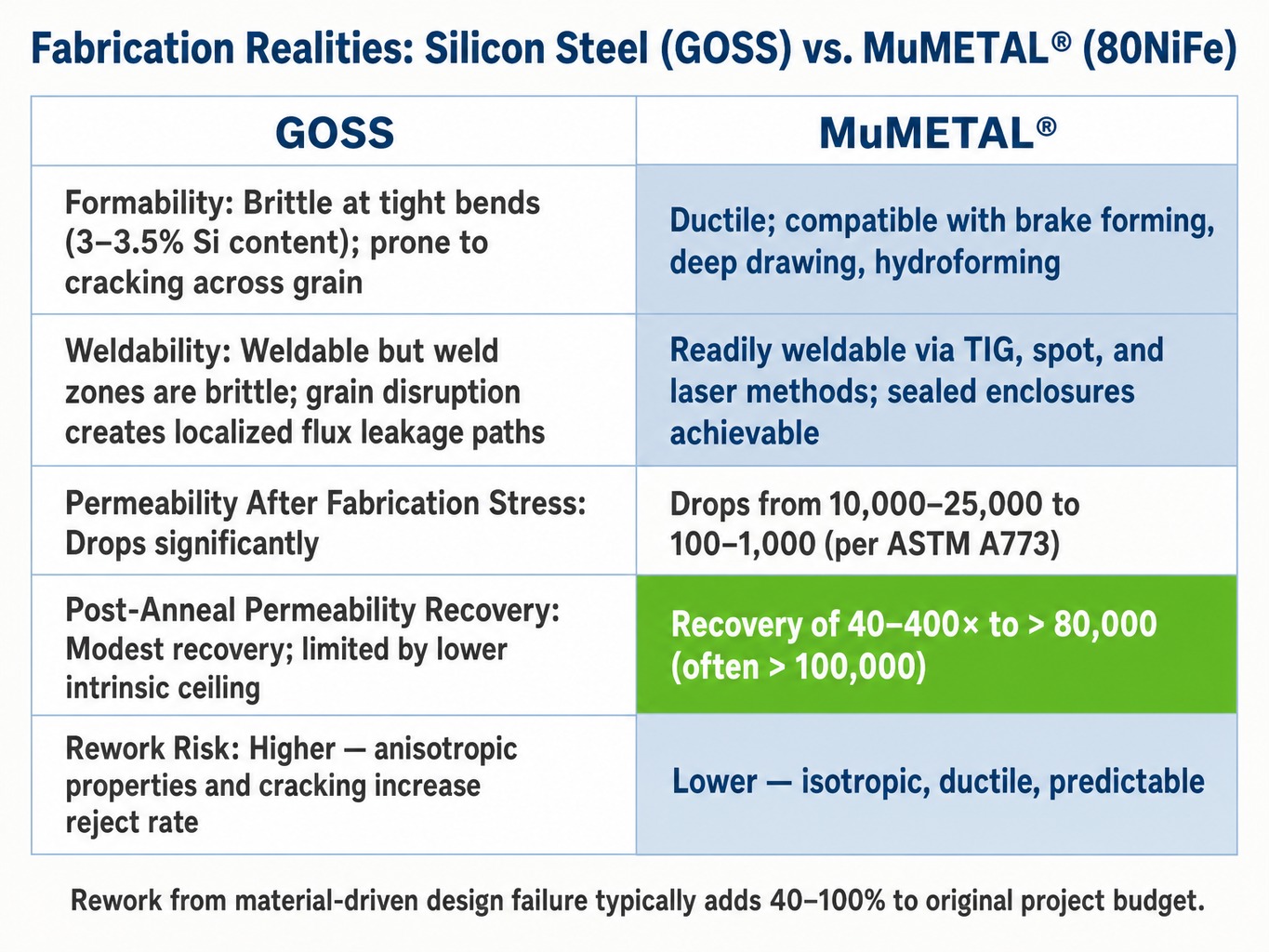
Hidden fabrication costs often eliminate silicon steel's price advantage in steel magnetic shielding.
Where Silicon Steel Genuinely Adds Value: The High-Saturation Outer Layer
Silicon steel is not always the wrong choice; it has a specific, well-defined role in certain multi-layer shielding architectures.
In applications with very strong ambient fields for example, near large power transformers or inside an MRI suite the flux density can be high enough to partially saturate a single layer of a high-permeability material like MuMETAL®. When a material approaches saturation, its permeability decreases rapidly, and its shielding effectiveness declines with it.
This is where silicon steel's high saturation induction of ~2.0 T becomes useful. In a nested, multi-layer shield, an outer shell made of a high-saturation material can absorb and shunt the bulk of the strong ambient field without saturating. This pre-attenuates the field, reducing the flux density that reaches the inner layer. The inner layer, now exposed to a much weaker field, can operate in its high-permeability regime to provide the final, deep attenuation.
This is a valid design, but it's important to note that purpose-designed high-saturation soft iron alloys like NETIC® exist for exactly this function. NETIC® iron alloy sheet is also classified as a high-saturation alloy with a Bs near 2.0 T, but it is processed specifically for shielding applications and offers more predictable, isotropic properties than GOSS. A common, effective architecture pairs an outer layer of NETIC® with an inner layer of MuMETAL®, with a carefully engineered air gap between them.
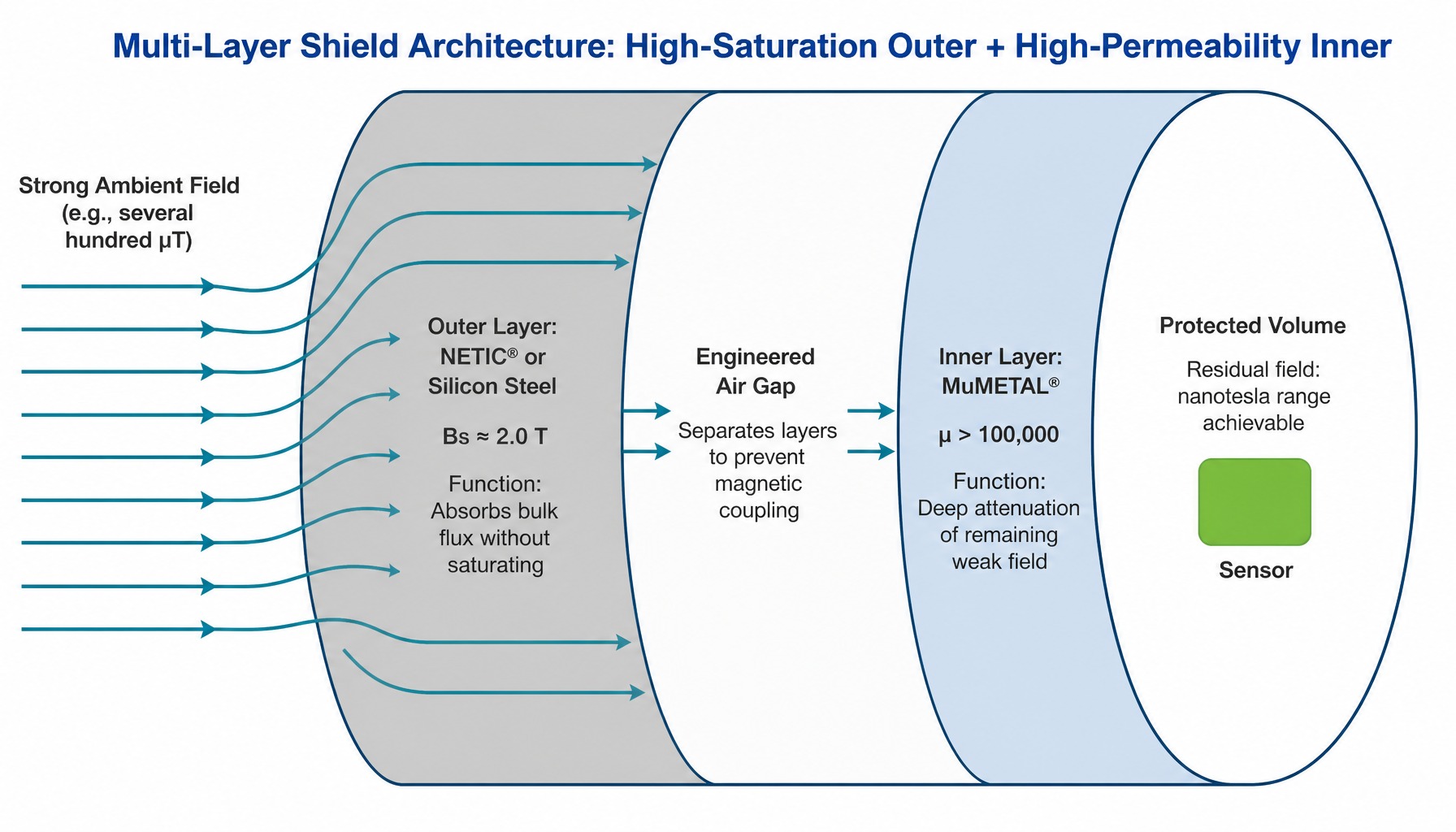
Multi-layer architecture shows where steel for magnetic shielding genuinely adds value.
Applications Where Silicon Steel Is Impractical for Magnetic Shielding
For the most demanding applications, silicon steel's performance ceiling is so low that it is not a viable candidate, regardless of price.
-
Quantum Computing and SQUID Magnetometry: These fields require extremely low-field environments, with residual fields often specified in the nanotesla (nT) range. This demands shielding factors of 1,000 to 100,000 or more. Silicon steel simply cannot deliver this level of performance without resorting to impractically thick and heavy multi-layer enclosures. The established solution is multi-layer shields made of MuMETAL® or Co-NETIC® alloys, often housed within a larger shielded room and incorporating active degaussing coils.
-
Cryogenic Environments: The magnetic properties of materials change dramatically at low temperatures. Silicon steel's permeability degrades significantly as it approaches cryogenic temperatures. For shielding superconducting electronics, SQUIDs, or other systems operating near 4 Kelvin, a specialized alloy like CRYO-NETIC® is required. CRYO-NETIC® stress annealed sheet is a nickel-iron alloy specifically processed to maintain high permeability at cryogenic temperatures.
-
Precision Medical and Scientific Instruments: Systems like electron microscopes, magnetoencephalography (MEG) equipment, and sensitive analytical instruments require more than just high attenuation. They need stable, uniform internal fields and low residual magnetization. Because silicon steel's permeability is direction-dependent and degrades more severely under the mechanical stress of shipping and handling, a silicon steel shield cannot hold that uniformity as reliably as a properly annealed 80NiFe shield that maintains its performance after installation.
If your application requires residual fields below ~1 microtesla, operates at cryogenic temperatures, or demands stable, predictable performance in a field-installed instrument, silicon steel should be ruled out early in the design process.
From Material Question to Validated Shield: Resolving the Cost-Effectiveness Equation
The central tension for any engineer specifying a magnetic shield is clear: choosing a material based on price per kilogram risks a far more expensive project than choosing based on cost per decibel of attenuation. But calculating that true cost requires knowing the actual shielding factor a given material, thickness, and geometry will deliver in a specific operating environment.
Closing the gap between material selection and validated performance requires modeling, fabrication, and testing to work together, so that a shield's attenuation is predicted before fabrication and verified before delivery.
This approach integrates:
- Material Selection: Alloys covering the permeability-saturation range, from high-permeability MuMETAL® and Co-NETIC® to high-saturation NETIC® and cryogenic-grade CRYO-NETIC®, allow the material to be matched to the application.
- Simulation and Modeling: COMSOL Multiphysics® simulation services and an online shielding calculator model shielding performance before metal is cut.
- Integrated Fabrication: Forming, welding, and final dry hydrogen annealing are performed in-house, so the anneal that restores magnetic properties follows the last fabrication step.
- Laboratory Testing: Attenuation performance is measured using Helmholtz coils and calibrated magnetic field sensors with rectangular probes in a quality lab and compared against the specification.
A calculator estimate is only a starting point. The material decision is settled when modeled attenuation is confirmed by measurement against the specification.
Tell us your residual field target and operating environment, and our engineers will model the material, thickness, and geometry to meet it. Contact our engineering team .
Conclusion
Cost-effectiveness in magnetic shielding is ultimately a question of attenuation delivered, not material purchased. While silicon steel has a legitimate, narrow role as a high-saturation outer layer in specific multi-shell designs, it is not a cost-effective primary shielding material for most applications.
For shielding challenges requiring significant attenuation especially those with residual field targets below a few microtesla, cryogenic operation, or compact, lightweight enclosures high-permeability 80NiFe alloys deliver a lower total installed cost. They achieve the required shielding factor with less material, less weight, less volume, and fewer fabrication complications. Before specifying any shielding material, first define the required residual field, the ambient field characteristics, and the operating environment. Only then can you calculate the true cost to solve the problem.
Frequently Asked Questions (FAQ)
What frequency range is silicon steel effective for in magnetic shielding?
Silicon steel provides useful attenuation for DC and extremely low frequency (ELF) fields up to several hundred hertz. At power-line frequencies (50-60 Hz), it still attenuates, but because its properties are designed for transformer cores rather than shielding, it delivers less attenuation than an 80NiFe alloy of the same thickness. From a few kilohertz up to 100 kHz, where skin depth becomes the dominant shielding mechanism, thinner high-permeability foils are typically more effective. High-permeability materials are not suited to high frequencies of 30 MHz and above.
What ASTM standards apply to silicon steel used in magnetic shielding versus 80NiFe alloys?
Grain-oriented electrical steel is typically covered by ASTM A876, which characterizes properties for transformer design. High-permeability 80NiFe shielding alloys like MuMETAL® conform to ASTM A753 Alloy 4, with permeability testing specified by ASTM A773. Specifying silicon steel to a transformer standard does not guarantee its performance in a shielding application.
Can silicon steel be used as an outer layer in a multi-layer magnetic shield?
Yes, and this is its most defensible application. A high-saturation outer layer of silicon steel or a purpose-designed alloy like NETIC® can absorb strong ambient flux that would saturate a high-permeability inner layer. The inner MuMETAL® layer then operates in its high-permeability regime, providing deep attenuation.
How does permeability degradation from bending compare between silicon steel and 80NiFe alloys?
Both materials lose permeability from fabrication stress, but 80NiFe alloys recover far more effectively. A final dry hydrogen anneal can restore the permeability of MuMETAL® by orders of magnitude, to 80,000-100,000+. Silicon steel's recovery is much more modest due to its lower intrinsic permeability ceiling.
What simulation tools can compare silicon steel and 80NiFe shielding performance before fabrication?
Finite element analysis (FEA) software like COMSOL Multiphysics® and ANSYS Maxwell can model shielding factor using nonlinear B-H curve data for different materials, thicknesses, and geometries. For initial estimates before a full FEA model is built, an online shielding calculator gives a quicker first approximation.
Is silicon steel suitable for shielding sensitive quantum computing environments?
Generally, no. Quantum computing and SQUID sensor applications require residual magnetic fields in the nanotesla range, demanding shielding factors that silicon steel cannot achieve without impractical thickness and weight. Multi-layer MuMETAL® or Co-NETIC® shields are the established solution for these ultra-low-field environments.