

Is Permalloy Equivalent to Mu-METAL®? An Engineer's Guide to Composition, Properties, and Interchangeability
Posted by Josh Wickler, Vice President of R&D on Nov 4th, 2026
Key Takeaways
- MuMETAL® is a specific 80Ni5Mo15Fe alloy within the broader, generic "permalloy" family; the two terms are not interchangeable.
- The critical difference is composition: MuMETAL® contains ~5% molybdenum (Mo), which is essential for achieving the highest permeability after annealing, while generic permalloys can have lower or no Mo content.
- A material's datasheet permeability is less important than its post-fabrication performance. Forming, welding, and punching can reduce maximum relative permeability from 10,000–25,000 to 100–1,000; only a final dry hydrogen anneal restores shielding effectiveness.
- To ensure performance, specify alloys by standard (ASTM A753 Alloy 4 / UNS N14080, the specification MuMETAL® meets), not by generic name, and verify the supplier's entire process from melt to final anneal and test.
- For cryogenic applications near 4 K, standard 80NiFe alloys are unsuitable; a specialized alloy like CRYO-NETIC® is required to maintain high permeability.
For an engineer writing a procurement specification for a magnetically shielded enclosure, the distinction between "permalloy" and "MuMETAL®" can seem like a minor detail. The terms are often used interchangeably. But is permalloy equivalent to MuMETAL®? The answer is no MuMETAL® is a specific 80Ni5Mo15Fe alloy conforming to ASTM A753 Alloy 4 within the broader permalloy family, and treating them as synonyms introduces significant performance risk. Typing "permalloy" on a purchase order can result in receiving material with different molybdenum content, grain structure, and post-anneal permeability than the design requires.
Whether a given 80NiFe permalloy grade can substitute for a proprietary alloy like MuMETAL® depends on three variables that most datasheets obscure: the exact chemical composition, the specific protocol of the final hydrogen anneal, and the resulting permeability recovery after the shield has been fabricated. When a procurement team substitutes a generic 'permalloy' for a specified MuMETAL® grade without verifying these factors, the resulting shield can fail acceptance testing weeks into integration and require rework.
This article provides a practical framework for design engineers and program managers, comparing these alloys by their material science, fabrication behavior, and ultimate shielding performance. We will cover:
- The critical difference between a generic family name and a specific alloy standard.
- How composition especially molybdenum content separates performance grades.
- The permeability lifecycle from raw sheet to finished, annealed shield.
- A practical checklist for evaluating interchangeability in your application.
Why "Permalloy" Is a Family of Alloys, Not a Single Specification
The core of the confusion stems from history. The name "permalloy" was first used at Bell Labs in the 1910s for a binary nickel-iron alloy, typically around 78.5% Ni and 21.5% Fe. Over the next century, the name became a generic descriptor for an entire family of soft ferromagnetic alloys with nickel content ranging from 45% to over 80%, often with additions of molybdenum (Mo), copper (Cu), or chromium (Cr).
In a procurement scenario, this ambiguity is a liability. An engineer who specifies "permalloy" on a drawing without calling out a specific composition or standard may receive anything from a 45NiFe alloy to an 80NiFe alloy. The shielding performance of these materials is dramatically different.
The term "MuMETAL®" originated separately in the 1920s as a trade name for a high-permeability alloy used for submarine telegraph cable loading. Today, MuMETAL® is the registered trademark of Magnetic Shield Corporation for a specific nickel-iron-molybdenum alloy conforming to the ASTM A753 Alloy 4 standard, with a composition of approximately 80% Nickel, 5% Molybdenum, and 15% Iron (UNS N14080).
Calling MuMETAL® "permalloy" is like calling a specific grade of stainless steel simply "steel." It is technically correct it falls within the category but it is not a precise identification and leaves performance characteristics undefined. For answers to common questions about how magnetic shielding works, visit our shielding FAQs .
Composition Comparison: Where 80NiFe Alloys Diverge
Even within the 80% nickel sub-family, alloys marketed as "permalloy" and alloys meeting the MuMETAL® specification can differ in ways that directly impact magnetic properties. The primary variables are molybdenum content and the control of trace impurities.
| Alloy Name / Trade Name | Ni % (Nominal) | Fe % (Balance) | Mo % (Nominal) | Governing Specification |
|---|---|---|---|---|
| Classic Binary Permalloy | 78.5% | ~21.5% | 0% | (Historical) |
| MuMETAL® | 80% | ~15% | 5% | ASTM A753 Alloy 4, UNS N14080 |
| Co-NETIC® AA | 80% | ~15% | 5% | ASTM A753 Alloy 4, UNS N14080 |
| Generic "80NiFe Permalloy" | ~80% | Balance | 3-4.5% | Varies / Often Undefined |
Why Molybdenum Content Separates Generic Permalloy from MuMETAL® Performance
Molybdenum is not a minor addition; it is the critical element that enables the highest magnetic performance in this alloy system. In 80NiFe alloys, an Mo content of approximately 5% accomplishes two crucial tasks. First, it increases the material's electrical resistivity, which helps reduce eddy current losses and improves shielding effectiveness at low AC frequencies.
Second, and more importantly, it helps drive the magnetostriction coefficient toward zero. Magnetostriction is the property of a material to change its shape during magnetization. A near-zero coefficient minimizes internal stresses, allowing for maximum domain wall mobility and, consequently, extremely high permeability after a proper hydrogen anneal. A generic "80NiFe permalloy" with only 3% or 4% Mo will exhibit a higher magnetostriction coefficient, higher coercivity (resistance to demagnetization), and a lower maximum permeability (mu-max) even after undergoing the same annealing cycle. The Mo content is the single largest determinant of whether two nominally similar 80NiFe alloys will perform equivalently as magnetic shields.
Specifying the Right Alloy: ASTM A753, UNS N14080, and Procurement Language
The most common procurement failure is writing a generic trade name on a purchase order without referencing a governing standard. This invites substitution with a lower-performance, lower-cost material that may appear equivalent on a surface-level datasheet.
To prevent this, use the correct specification chain:
- ASTM A753 Alloy 4 defines the chemical composition and minimum property requirements for this class of material.
- UNS N14080 is the Unified Numbering System designation for that alloy.
- MuMETAL® is the trade name for material manufactured by Magnetic Shield Corporation to conform to this standard.
For aerospace and defense applications, MIL-N-14411C is another relevant standard. Because manufacturers other than the maker of MuMETAL® also produce ASTM A753 Alloy 4 material under their own trade names, specifying the standard rather than a trade name is the first step. However, as the next section explains, composition alone does not guarantee performance.
Permeability Before and After Fabrication
Two sheets of 80Ni5Mo15Fe alloy from different suppliers can deliver dramatically different shielding performance in a finished component, even if their mill certificates show identical compositions. The reason is that shielding performance depends on permeability in the as-installed condition, which is a function of the entire processing chain from melt practice through final heat treatment.
The permeability of a high-nickel alloy shield follows a three-state lifecycle:
- As-Received Sheet: Stress-annealed sheets of MuMETAL® arrive from the mill with a maximum relative permeability of 10,000–25,000 . This material is soft enough for fabrication but has not yet reached its peak magnetic properties.
- After Fabrication: Any mechanical stress from forming, punching, drawing, or welding introduces dislocations and residual stress into the material's crystal lattice. These defects "pin" magnetic domain walls, severely restricting their movement. As a result, the permeability of an as-fabricated part collapses to a maximum relative value of just 100–1,000 , measured per ASTM A773. At this stage, the shield's performance is negligible.
- After Final Anneal: To restore and maximize magnetic properties, the finished shield must undergo a final heat treatment in a controlled-atmosphere furnace. For MuMETAL®, this is a dry hydrogen anneal. This process relieves fabrication-induced stresses, promotes grain growth, and removes interstitial impurities like carbon and sulfur. The result is a permeability increase of 40 to 400 times , recovering the alloy's high shielding capability.
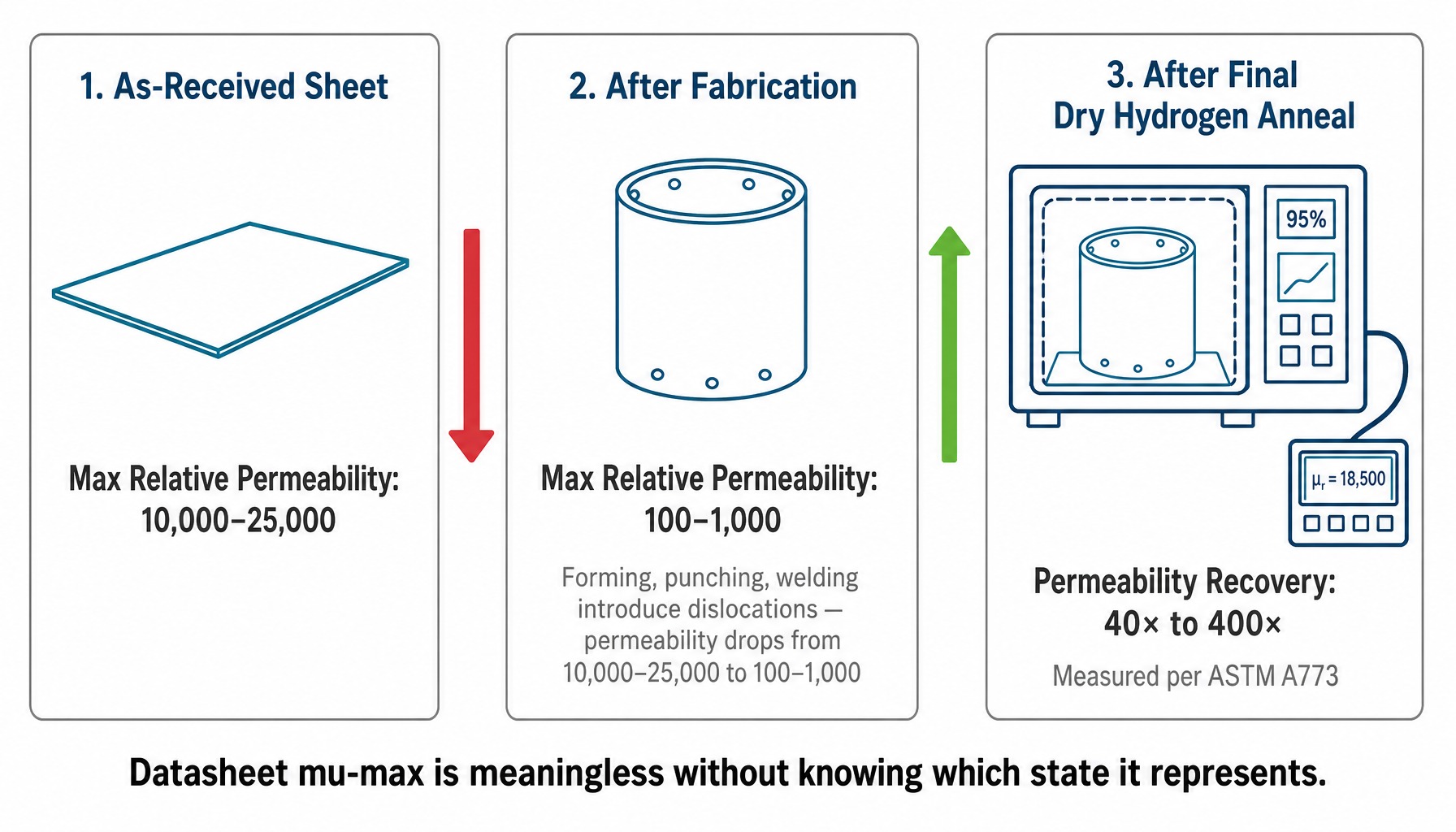
MuMETAL® permeability: verify post-fabrication recovery, not just the datasheet value.
This lifecycle means a datasheet's mu-max value is meaningless unless you know whether it refers to the as-received sheet, the as-fabricated part, or the final, annealed shield. Ask any supplier to state which of these three conditions its quoted value represents.
Read more: Deep Drawn MuMETAL® Cans - Magnetic Shield Corporation
Can You Substitute Generic Permalloy for MuMETAL® in a Shielded Enclosure?
Substitution is feasible only when the replacement material meets the same composition specification, undergoes an equivalent final hydrogen anneal, and is validated by permeability measurement in its final state. Before accepting a substitute for MuMETAL®, an engineer should apply a four-point checklist.
- Composition Verification: Request a complete material test report or mill certificate for the specific heat lot being supplied. Confirm that molybdenum content is in the 4.8-5.2% range that ASTM A753 Alloy 4 sets for MuMETAL®, not a lower value typical of generic permalloys.
- Weldability and Post-Weld Annealing: MuMETAL® is readily weldable, but the process creates a heat-affected zone with degraded permeability. The entire welded assembly must be hydrogen-annealed after welding to restore magnetic properties. Confirm that the supplier of the generic permalloy can provide data on weldability and, more importantly, that your fabrication partner has the capability to perform the required post-weld final anneal.
- Cryogenic Performance: If the application involves a quantum computing cryostat, SQUID magnetometer, or other superconducting system, be aware that the permeability of most 80NiFe alloys drops significantly at temperatures near 4 K (-269 °C). For these environments, a generic permalloy is a high-risk choice. A specialized alloy like CRYO-NETIC® , which is formulated to maintain high permeability at cryogenic temperatures, is the appropriate selection.
- Simulation Validation: Before committing to a material, model the expected shielding factor. Using software like COMSOL Multiphysics or Magnetic Shield Corporation's online shielding calculator, you can compare the performance of different alloys. The key is to use realistic B-H curve data representing the material in its final, annealed state not an idealized datasheet value.
Read more: Thin, Flexible Magnetic Shielding for Quantum Computing - Magnetic Shield Corporation
From Alloy Selection to Tested Shield: Controlling the Process Chain
The central problem this article identifies is the gap between a material name on a datasheet and the actual shielding performance of a finished component. Magnetic Shield Corporation addresses this risk by keeping melt, fabrication, annealing, and testing within one process chain.
The chain begins with alloys of verified composition, such as MuMETAL® (80Ni5Mo15Fe conforming to UNS N14080), Co-NETIC® AA (which meets the same standards), CRYO-NETIC® for cryogenic applications, and NETIC® (a high-saturation soft iron alloy for diverting stronger fields). MuMETAL® is supplied as 1.58mm (.062") sheet, with gauges available from .05mm (.002") to 5mm (.197"). Unlike copper, which is difficult or impractical to weld, MuMETAL® can be welded into fabricated shield assemblies.
Magnetic Shield Corporation's in-house fabrication capabilities, including welding, convert these alloys into custom shields , which then undergo a final perfection anneal in dry hydrogen furnaces. Where a shield requires an aperture, its collar should extend outward by a distance equal to or greater than the longest edge of the aperture or the hole diameter. The company then validates the outcome: its quality laboratory uses Helmholtz coils and magnetic field sensors to measure the attenuation of finished parts, and all DC permeability values are measured per ASTM A773 . Keeping these steps in one facility lets you compare the finished shield's measured performance directly against your design requirements.
For complex shielding requirements, Magnetic Shield Corporation's engineers can work from your concept through fabrication and measured validation of production parts.
Tell us your attenuation target and operating environment, and our engineers will specify the alloy, geometry, and anneal cycle to meet it. Contact our engineering team .
MuMETAL® is suited to precision shielding problems such as the quantum computing cryostats and SQUID magnetometers discussed above. For MRI room shielding, it is typically not cost-effective and exceeds what the application requires, and for contractors working to low project budgets, its material cost is usually prohibitive.
Conclusion
While related, "permalloy" and "MuMETAL®" are not interchangeable terms. Treating them as synonyms on a drawing or purchase order introduces measurable risk to a project's success. The name on the material is far less important than its verified chemical composition, the integrity of its processing chain, and its measured magnetic properties after final fabrication and annealing.
Before specifying any 80NiFe alloy for a critical magnetic shielding application, first define the required field attenuation. Then, confirm the alloy conforms to ASTM A753 Alloy 4 , the MuMETAL® composition, and, most importantly, partner with a supplier who can validate the shield's performance in its final, as-installed state not just on a raw material datasheet.
Frequently Asked Questions
What ASTM specification should I reference when procuring MuMETAL® for aerospace or defense shielding?
Reference ASTM A753 Alloy 4 for MuMETAL® composition and property requirements, along with UNS N14080 as the unified numbering system designation. For military procurement, MIL-N-14411C may also apply. Always specify the full standard on the purchase order rather than using a generic name to prevent substitution with non-equivalent grades.
What is the maximum relative permeability of MuMETAL® after dry hydrogen annealing?
Magnetic Shield Corporation's stress-annealed sheets start at 10,000–25,000 maximum relative permeability. After fabrication stresses, this drops to 100–1,000. A final dry hydrogen anneal recovers permeability by a factor of 40 to 400. The final mu-max depends on alloy purity, part geometry, and precise control of the anneal cycle, with all DC permeability values measured per ASTM A773.
Is MuMETAL® weldable, and does welding degrade its magnetic shielding properties?
Yes, MuMETAL® is weldable. However, the welding process creates a heat-affected zone where the grain structure is altered and magnetic permeability is severely degraded. To restore performance, the entire welded assembly must undergo a final dry hydrogen anneal. Planning for this post-weld heat treatment is a critical step in the design phase.
How do I specify MuMETAL® shielding for a quantum computing cryostat enclosure?
Standard MuMETAL® (80Ni5Mo15Fe) loses significant permeability at cryogenic temperatures. For enclosures operating near 4 K, specify CRYO-NETIC®, an alloy specifically formulated to maintain high permeability at these temperatures. Define your required residual field, operating temperature, and mechanical constraints before selecting material thickness and layer configuration.
Can COMSOL simulation predict shielding factor differences between generic permalloy and MuMETAL®?
Yes, COMSOL Multiphysics can accurately model shielding factor differences, provided you input the correct B-H curve data for each alloy. The critical input is the permeability of the material in its final, fabricated-and-annealed condition, not an idealized datasheet value.
Why do some suppliers label their product permalloy when it does not meet UNS N14080?
The term "permalloy" is not a controlled trademark and has been used for decades as a generic label for a wide range of high-nickel iron alloys. A supplier can describe a 78Ni/4Mo alloy as "permalloy" even if its properties differ from those of MuMETAL® under ASTM A753 Alloy 4 (UNS N14080). Always request a complete material certificate and verify the composition before accepting a substitute.